Like us on Facebook

Showing posts with label recipe. Show all posts

It's khinkali making time!


How to make KHINKALI, the most wonderful pockets of pleasure you have ever met....


 Khinkalis are THE dish to eat in Georgia. They can be made with cheese, but frankly, the meaty kind are so juicy, they are the most eaten version.
So, you start with basic ingredients for the filling:
Ground cilantro (and parsley, too, if you like).
Ground beef and pork, a 75/25 ratio, and a little salt pork
Salt (don't go cheap on the salt, it's important...)and a little red pepper, in flakes or powder, a little svanuri marili , a mixed salt that is oh, so, so yummy...You can make it yourself. Just follow the link!
Some water.
Black pepper, for sprinkling on the khinkalis when you serve them
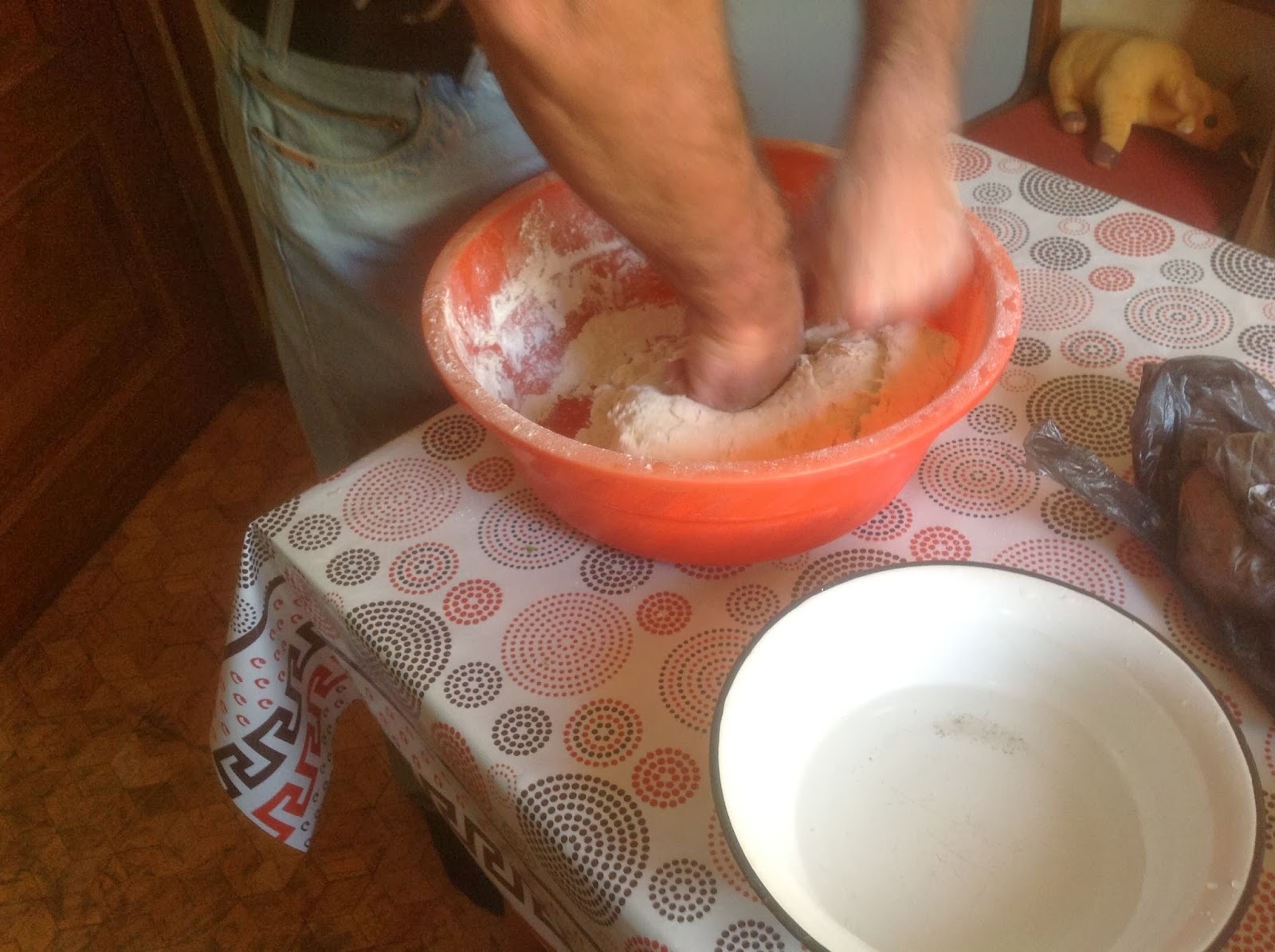
You then prepare the dough with flour, salt and water. No yeast needed. One kilo of flour (2.2lbs) is enough for 4 people, or about 15 khinkalis. People can eat from 4 to 7 khinkalis..


Here you see the kneading technique used in Georgia, where the dough is pounded with the fists, rather than turned as done in the US or Europe.


The dough will have to rest a bit. 30 minutes is enough, since it doesn't need to rise.


The ingredients are then mixed with the hands. They need to be thoroughly mixed. Then, a little water is added, to make the mixture as loose as a very heavy pancake batter. The water is a very important part of this dish, as it will separate inside the khinkali and provide the "juice" part of this dish, an absolute necessity.

you may think you have enough water, but at that point, add a little more, you won't regret it...

Then, pound the dough onto a rolling surface, using a little flour
Roll the dough out to about 1/2 thickness, then cut round disks out with a glass or basic cutter.


Then take each individual cutout, and roll it to about 1/8" thickness, keeping the shape as round as possible.
Now, take a large tablespoon of the meat mixture. The water will separate a bit, and that is ok. Gather the sides of the round by making folds. They say in Georgia that you are supposed to fold it 19 times for the perfect khinkali, and that can be a goal, but most will have between 11 and 15 folds. Squeeze all the folds together at the top, making sure that the khinkali is sealed and pinch off the excess. The result should look like a large fig.


Place the khinkali on a floured surface. Do not allow them to touch.


While you are making the khinkalis, warm up a large amount of water. Add a little salt.
Drop the khinkalis in boiling water, a few at a time as so not to make them touch while cooking. The khinkalis are eaten as soon as they are cooked, so you make a few, eat a few, make a few, eat a few...or buy a super large pan...  :)

Let the khinkali boil for about 8 to 10 minutes. They will first sink to the bottom, like pasta, and rise up and float. At that point, they are done. Take them carefully out of the water with a slotted spoon and drop them on a platter or an individual plate. 
Sprinkle with a little or a lot of pepper, depending on taste. Serve immediately! Khinkalis are eaten hot, and with your fingers! The trick is to take a little bite, then let the steam escape. Do not let the juice escape, drink it out of the hole made, then eat around. The tradition is not to eat the little "hat" made by gathering the dough. More room for more khinkalis!
And if you are of age, khinkalis are followed by  a tall glass of beer.

Gaumarjos! 
Enjoy!


Ormotsi = a celebration of life 40 days after the death of a person inGeorgia.


Ormotsi: meaning 40, as in 40 days after the passing of a loved one..


It is a big honor to be included in a supra, called ormotsi, in this case, and the honor came to me in 2008, when my sister-in-law's mom passed away.
After the death, there is a week-long wake around the deceased, and this in her house, where she is on her bed, and visible to all who enter the bedroom. I had no desire to go in, since that was largely a foreign concept to me, and since I had just met the family, my place was certainly not there.
So, for a week, the family and friends come in, and cry, sometimes very loudly, around their dearly departed. It is a form of mourning that is interesting in the way that the people, with their cries, really express themselves in a physical way, and this together. This form of unity in mourning really differs from what the Western world does.
Then, a week later, the body is taken out of the house, accompanied by loud cries from the family and friends, and the casket is left open and placed on the shoulders of the carrying team, usually family members. In that case, her sons did. Then, the walking procession starts to the cemetery, still in a very vocal way. It was frankly heart-wrenching, but the family was so exhausted from crying, that they hardly seem to notice the world around. You will excuse the lack of pictures of this ordeal, of course, as I felt it totally inappropriate to take any.
The casket is then closed, put in the ground, and an orthodox priest says a few words, incense is being burned, and then the soil is added to the hole. When filled, the children, grown and young, throw themselves on the mound and cry more. This display of affection was to me a great introduction to the meaning of family in Georgia. Family ties are incredibly strong, partially, I suppose, because they live together with older and younger generations. Always a grandma on hand, or a grandpa, and they absolutely adore their children and grandchildren, tell them so all day, and have physical contact, hugs and such very often. Coming from a civilization where you had to be "seen not heard", it was unreal to me..

So, the mound over the casket is not covered for a period of 40 days after the death. It allows the soul of the dead to rise up. The final stone is put on the 40th day, with a ceremony not unlike the burial itself, but more subdued..All the personal papers of the deceased, such as passport and ID papers, are also put into the casket, sealing the "forever" part of the death..ormotsi means 40, and therefore the celebration of life is called ormotsi, since it has been exactly 40 days.

then, the party starts!!
Imagine hundreds of people, literally, coming to eat at your place.. I was told we were 300, but not all at the same time..People come in and contribute, give a certain amount of money, knowing it will more than cover what they will eat..A person sits at a single table, and takes in the contribution, and the names and amount are written in a special book, used, no doubt, to thank people later. no flowers are brought.
The amount of bread needed filled a room, there was stuff everywhere. It was awesome!
and the feast was AMAZING!

This is what we ate:
In order of appearance (I took notes.... :). Each line is one course..Keep in mind that it was during Lent, so most of the usual meat dishes had mushrooms instead..
-radishes, sprigs of fresh tarragon, and green onions
-lobiani: fresh bread filled with refried beans
-cucumbers, peppers and tomatoes cut and on a plate together, with chopped cilantro
-djondjoli, or pickled sprouts, and other pickled items
-round corn cakes called mchadi. A bit like corn bread..but better..a specialty of Western Georgia
-little blini with black mushrooms inside, rolled
-cooked spinach
-carrot salad
-potato salad
-cauliflower and walnut salad
-hot red beans
-chakapuli, which could have been meat, but was mushroom, with red spices
-in a tiny cup: wheat berries, honey and walnuts(that was wonderful)
-mashed potatoes and dill weed
-adjapsandali, a sort of ratatouille with eggplants, peppers, potatoes, tomatoes
-fruit platter with bananas, cut apples and other season fruit
-assorted cakes with cream, large slices
-sweet rice and apricots
- chai tea and Georgian coffee
and then, when they want the guests to leave, they serve chilaplavi, which is a rice dish, usually with mutton meat, but that day was mushroom). The guests then understand that it is the end of the meal..

-of course, all is served with copious amount of Georgian wines, mineral water and lemonade!

An old tumb in the cemetery
Georgian ladies are very often dressed in black. They wear their loss with their clothes, and follow a very strict rule of mourning periods. It is counted in months and years for family members. Therefore, a lady can have several members of the family pass away when she is in her fifties, which means that she will dressed in black for years. Along with the black clothing, she will also restrain from an fun activities, such as going to a restaurant or on vacation...Too strict for the average French girl , I'm afraid, but I have an immense respect for these women who wear their sorrow..It gives you a sense of loss, however, that I am not sure I could endure day after day.

Contact Giga on his Facebook page 
for a fun travel time in Georgia.
or message us directly at:
Menu Voyage