THE WONDERFUL FOOD OF SAKARTVELO, an ongoing love story..
Meet
“puri”, or bread in Georgian! This one is a special shape because it goes through a special process.
Here in Georgia, they cook bread in a round clay oven. It looks somewhat like a washing machine tumbler, and has hot ambers and a small fire in the bottom. The sides of the oven are hot, very hot...so the baker takes a ball of dough, and, in order to stick it to the side of the oven, has to stretch it a bit, hence the shape of the bread. When the bread is done, it falls from the side of the oven into the middle. It is then rescued and sold..It tastes, amazingly enough for us French in persuasion, like a crisp baguette! It has holes, and is crunchy on the outside and tender in the inside. Very yummy!
Other breads are cooked in regular ovens, and they don’t equal the taste of this cool one. They have loaf shapes, donut shapes and all kinds of other shapes.
Now, for a little treat, imagine this bread in a smaller size, the size of a hefty trout, let say. Now, make a slit in the middle, insert crumbled cheese, such as feta. Put it back in the oven, melt the whole mess, take it out, and then crack an egg on the top! Now, all you need is a fork! That is called “
khatchapuri imayruli” and it is served on the western side of Georgia. That will equal and then surpass pancakes, I assure you! You will not want to eat for hours..but you will have to! :)
And now, for
Khatchapuri, the answer to quesadilla in Georgia..devoured hot and melting..or cold and still hyper yummy! If it is filled with refried beans, like the dish on the left, it is called
lobiani, because lobios are beans...just as yummy! In fact, this is not unlike Mexican cooking!


Since food is being served at all times of the day, the khatchapuri is eaten when it comes out of the fry pan, or oven. Mostly, with a cup of
chai or tea. It is cut with scissors and served in pie-shaped portions. Jame! is the expression for "Eat, eat!", a national obsession, make the guests eat...
 Khinkali,
 the answer to raviolis in Georgia. Here, they are prepared at home, or can be bought ready-made, but the taste suffers. The way to make this at home is to mix flour and water, no yeast, into a sort of bread dough. The dough is then kneaded with the fists and allowed to rest a while. Then, the dough is rolled very thin, and cut into rounds. Then the khinkalis are filled with a mixture of veal, beef, onions, cilantro, salt, garlic and water. The mixture is quite runny, for a very good reason. The water will eventually separate from the meat but stay in the little pouch made. That is the secret of the khinkalis: They have to
have a large amount of “juice” in them when you bite into them.
The little “bags” are sealed at the top and dropped into hot water, allowed to cook boiled for 10 to 12 minutes, and then devoured after a hefty pepper shaking. To be enjoyed with a very large beer..
The quince, or “
comchi” here, is used in a variety of ways. It is boiled with a little sugar and the water that it is boiled in is served as “comchi compote” in a cup, to be had like a cup of tea, hot. Very interesting!
The pieces of quince are also eaten in a mashed form, a sort of heavy jam, used on bread. They can also be eaten in their hot syrup, or mixed with cooked white rice. Comchis are supposed to be good for your stomach and for someone with a persistent cough.
One cannot think of Georgian cooking without thinking of
walnuts or "nigosi". They appear in almost every dish! Aside from
satsivi which we will be covered later, they are used to season sweet and savory dishes.
One of these dishes consists of slices of eggplant, or
badrigiani that have been partially peeled and then broiled to get a smoky flavor. The walnuts are then ground, spices are added, and the slices of eggplants are then slightly filled with the nuts, and folded in 3. Easy, yet delicious..By the second day, the juices of the eggplant and the walnuts mix and marry and the result is awesome!
Another use for walnuts is for a sweet dish called
dzandili made of round wheat berries, cooked and cooled, mixed with honey, white raisins, and ...walnuts! Served cold in a glass.

An amazing product is made out of ...walnuts..and grapes, the second main ingredient in Georgia. It is called
choorchrela. Walnuts halves are threaded on a light string, a few feet long. Then, grape juice and flour are boiled to make a heavy paste, called
pelamushi, and the strings of walnuts are dipped repeatedly in the mixture to become completely covered and sealed in a tough covering. Strangely enough, it does not taste sweet! The taste of the walnuts is there, and the grape taste equally present. A most interesting use of walnuts! Can be kept for months! But better eaten in the fall, after the harvest.
Walnuts agrement fish sauces, chicken sauces, turkey dishes, vegetable dishes, desserts. You will find them hidden in layer cakes, one here and there..very sparingly..


Yogurt soup! Or
mazoni soupi! Now, that is odd! First, onions are fried in butter, water and rice are added, then, a little dusting of flour, then, a hefty dose of yogurt, plain, of course, and at the end, beaten eggs. Imagine Chinese egg soup and put in some yogurt. Quite tasty, but surprising. The slight bitterness of the yogurt and the blandness of the eggs mix elegantly. And where do you get your yogurt, brought home in simple glass jars and covered with a heavy cream, you say? Well, the man from the hills will sell it to you! He comes on foot leading his horse!Incredible!
The use of fruit in Georgia is equally surprising. From the pitcher of blackberry homemade juice, complete with the berries at the bottom of the pitcher and served later as a dessert, to the alubali or sour cherries dropped into your cup of tea, the uses differ so much from the Western culture!
The markets here abound with citrus fruits, principally lemons and oranges. Georgia is also well known for its citrus, as this is a country where subtropical plants grow. The lemons are used for tea, another production of Georgia, in slices, and the oranges are cut in slices, together with kiwis and bananas for fruit platters.

So, how about
pakhlava? I know what you are thinking...It's Bakhlava, right? Well, no...Took me 3 years to hear that it started with a "p" sound, and it is very different from what you would think of in Greece or in Turkey, for example.It is made with mock puff pasty dough, handmade, evidently, and then, you whip egg whites and sugar until it becomes very white and thick, like a stiff meringue prior to cooking, and you add ground nuts. Walnuts are good, but almonds are nicer. Then, you make a couple of layers of that, then top with melted butter. Half-way through cooking, add honey with a brush and let it cook a little longer. You can't imagine the goodness of that. Not syrupy like bakhlava, but sticky and yummy.
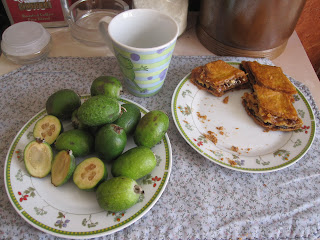
Here, shown with "f or peikhoa" ..I still don't know what fruit that is, but all I know is...It's very good! any ideas of what that would be? Citrusy, and almost gelatinous, and you can eat the skin. Almost tastes like a tart kiwi or a tart passion fruit? Yummy..and it cuts the sugar high of the pakhlava..
Tried to make this delicious pakhlava at home in France last week, and, yes, as expected, it was a dismal failure...Argh! Eka is just a specialist, and I will not try to outdo her. Pretty obvious it's better in Georgia..
And now for a summer treat....
MSVADI!!! One cannot go to Georgia and not have a bbq! It would be totally unacceptable!

So, msvadi is just that, a bbq of meat. Done on
champuri, or skewers, they can be pieces of meat, or kababi, a blend of ground meat that is very carefully attached to the skewer, taking particular care to take the air out of the meat. Then, it is rolled in flat bread, called
lavashi, and eaten with ajika, or other hot sauce..Yum!

Happy eating, everyone!

 Ground cilantro (and parsley, too, if you like).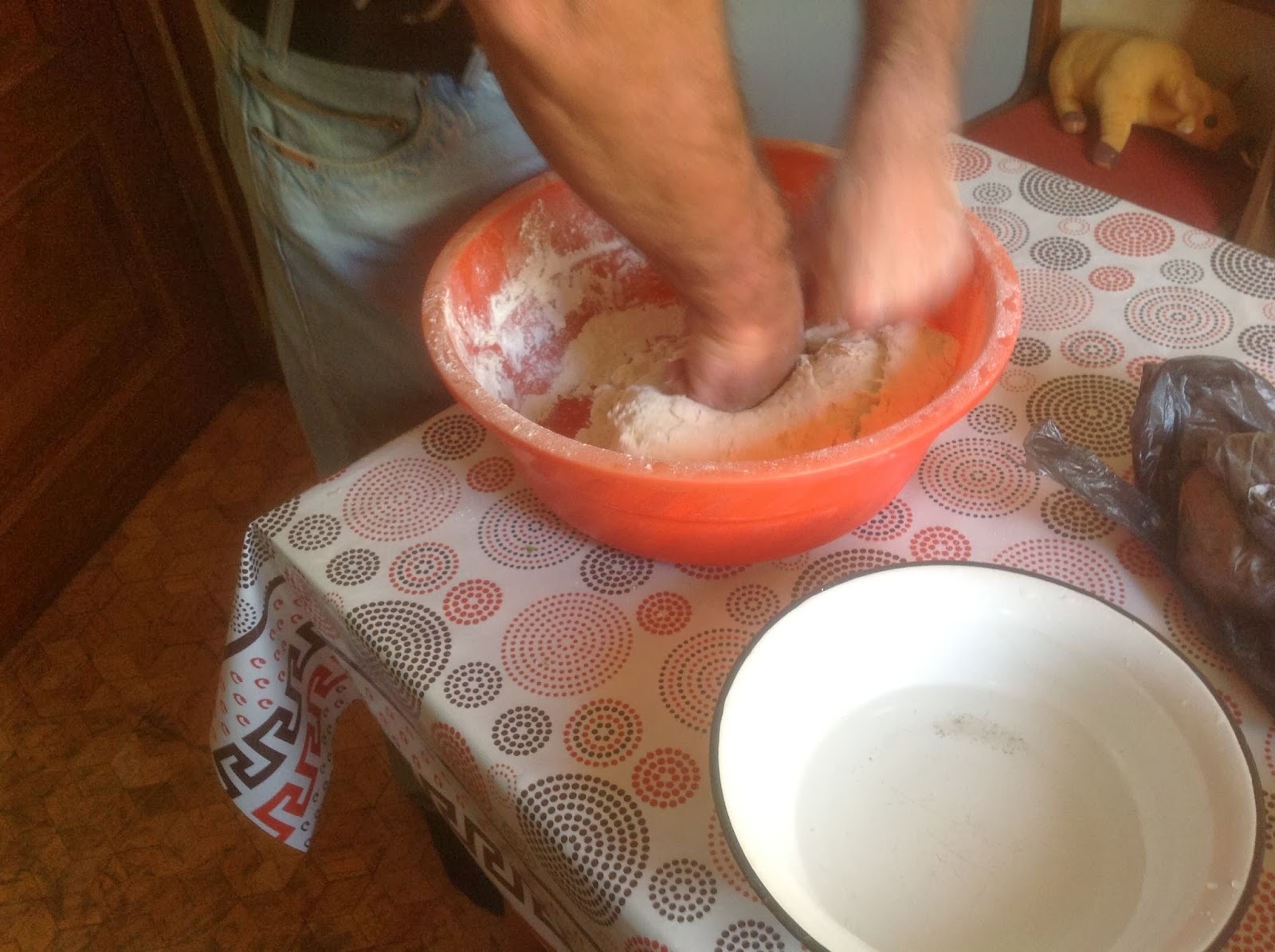
 You then prepare the dough with flour, salt and water. No yeast needed. One kilo of flour (2.2lbs) is enough for 4 people, or about 15 khinkalis. People can eat from 4 to 7 khinkalis..


 Roll the dough out to about 1/2 thickness, then cut round disks out with a glass or basic cutter.


 Let the khinkali boil for about 8 to 10 minutes. They will first sink to the bottom, like pasta, and rise up and float. At that point, they are done. Take them carefully out of the water with a slotted spoon and drop them on a platter or an individual plate.